
Building a Reliable Payment Retry System for Money Transfer Platforms
A reliable payment retry system does more than simply create a new payment attempt when the previous attempt fails. It must first determine whether money may already have been captured, understand the state of every payment attempt, prevent unsafe retries, and reconcile delayed provider responses before allowing another checkout.
A reliable payment retry system does more than simply create a new payment attempt when the previous attempt fails. It must first determine whether money may already have been captured, understand the state of every payment attempt, prevent unsafe retries, and reconcile delayed provider responses before allowing another checkout.
For a money transfer platform, a robust retry system should:
- Check all payment attempts before creating a new one.
- Prevent retries when a transaction has already been successfully paid.
- Distinguish between states: failed, cancelled, authorized, captured, and refunded attempts.
- Handle late provider success notifications safely.
- Use provider polling as a fallback when webhooks are delayed or missed.
- Apply configurable retry and polling backoff.
- Maintain transaction and payment-attempt state consistently.
- Lock the transaction before making critical state changes.
- Alert operations when a payment requires human review.
- Keep an audit trail of payment attempts and state transitions.
This is particularly important in cross-border money transfers, where payment providers operate asynchronously and a customer-facing application may receive a different payment state from the one ultimately recorded by the provider.
In This Article
- Why Payment Retries Are More Complicated in Remittance
- What Is a Payment Retry System?
- The Biggest Risk: Retrying From Stale Payment State
- A Reliable Retry System Must Be Attempt-Aware
- The Payment States a Retry Engine Should Understand
- Preventing Duplicate Payments Before They Happen
- Why Authorized Payments Need Special Treatment
- What Happens When a Provider Succeeds After a Local Failure?
- Why Payment Attempt Promotion Matters
- Polling: The Safety Net Behind Payment Webhooks
- Transaction Locking Is Critical
- Alerts Should Be Part of the Retry Architecture
- A Reliable Retry System Needs Idempotency
- What Should a Payment Retry Monitoring Dashboard Show?
- What a Reliable Payment Retry Architecture Looks Like
- Checklist: Does Your Remittance Platform Have Reliable Payment Retry Logic?
- How RemitSo Approaches Payment Reliability
- Frequently Asked Questions
Why Payment Retries Are More Complicated in Remittance
Payment retries look simple from a customer's perspective:
- A customer attempts to pay.
- The payment fails.
- The application displays: Payment failed → Try again
But underneath that button, several things may already have happened. The provider may have:
- Authorized the payment
- Captured the payment
- Delayed its response
- Processed the payment but failed to deliver the webhook
- Returned a timeout even though the payment succeeded
- Received the payment request while the platform still shows the attempt as pending
- Processed an earlier attempt while the customer starts another checkout
This creates one of the most dangerous situations in payment processing: The platform believes the payment failed, while the provider knows that the payment succeeded.
If the customer is allowed to retry based only on the platform's local state, the second checkout can potentially result in another charge. For a remittance business, that is not simply a technical error—it can become:
- A duplicate customer charge
- A refund investigation
- An operations case
- A reconciliation exception
- A customer support escalation
- A compliance and audit concern
- A settlement discrepancy
That is why payment retry logic needs to be designed as part of the overall payment state management and reconciliation architecture.
Build Safer Payment Retry Controls Into Your Remittance Platform
RemitSo connects payment processing, transaction management, reconciliation, and operational controls so MTOs can manage payment exceptions before they become financial problems.
- Payment attempt management
- Transaction state management
- Payment status visibility
- Provider integration workflows
- Reconciliation controls
- Operational exception handling
What Is a Payment Retry System?
A payment retry system is the set of rules and infrastructure that determines when and how a customer can attempt payment again after an unsuccessful, incomplete, or uncertain payment attempt.
Basic Implementation (High Risk)
Production-Grade Implementation (State-Aware)
A production-grade implementation is state-aware and checks the payment attempt, related attempts, provider status, and whether money is already captured before deciding whether another attempt can safely be created.
A retry is not simply another API call. It is a state transition that should only happen after the platform has established that another payment attempt is safe.
The Biggest Risk: Retrying From Stale Payment State
One of the most critical problems in payment systems occurs when the retry endpoint trusts stale local state. Consider this sequence:
-
Step 1: Customer starts payment
Transaction TX123 creates Attempt A (PENDING). -
Step 2: Customer completes payment
The provider receives the payment, but the provider response is delayed. The platform still sees Attempt A as PENDING. -
Step 3: Customer sees a failure or timeout
The customer clicks Retry Payment. -
Step 4: Platform creates Attempt B
If the retry endpoint simply cancels Attempt A and creates Attempt B, the platform creates a dangerous window:
Attempt A: Provider may still capture
Attempt B: Customer pays again
The customer can now potentially have two payment attempts holding funds. This is why a retry endpoint must check the entire transaction history before cancelling the current attempt or creating another checkout.
A Reliable Retry System Must Be Attempt-Aware
A transaction should not be represented by only one payment attempt. In real-world payment processing, a single transaction lifecycle often looks like this:
Transaction
- ↳ Payment Attempt A → FAILED
- ↳ Payment Attempt B → CANCELLED
- ↳ Payment Attempt C → CAPTURED
The transaction's financial reality is determined by all payment attempts associated with it. Therefore, retry logic should ask:
"Has any payment attempt associated with this transaction already succeeded or captured funds?"
...rather than simply asking:
"Did the current payment attempt fail?"
That distinction prevents an entire class of duplicate-payment scenarios.
The Payment States a Retry Engine Should Understand
A reliable payment retry system needs a clear state model. At minimum, it should distinguish between:
| Payment State | Retry Consideration |
|---|---|
| INITIATED | May be retryable depending on lifecycle stage |
| PENDING | Usually requires explicit status verification before action |
| AUTHORIZED | Do not blindly retry (funds are placed on hold) |
| CAPTURED | Block retry (payment completed) |
| FAILED | Potentially retryable after provider state check |
| CANCELLED | Potentially retryable, but verify provider state first |
| PARTIALLY REFUNDED | Requires careful manual review |
| FULLY REFUNDED | Usually should not automatically restart |
| EXPIRED | Retry only after confirming provider state |
FAILED does not automatically mean "safe to retry." A platform may record an attempt as failed locally while the provider processes it successfully later. Local state and provider state must be reconciled.
Preventing Duplicate Payments Before They Happen
The strongest payment retry architecture prevents duplicate payments before creating the second attempt.
Retry Request → Lock Transaction → Inspect Every Payment Attempt → Any Captured/Authorized Attempt? → Block Retry / Evaluate Retry → Cancel/Close Safely → Create New Attempt
This design is substantially safer than cancelling the current attempt and creating a new one without checking historical attempts.
Protect Every Payment Attempt Before a Retry Happens
Payment retry controls work best when transaction state, payment attempts, and provider responses are handled together rather than treated as separate workflows.
- Attempt-level retry checks
- Captured payment protection
- Authorized payment handling
- Provider state verification
- Transaction locking
- Idempotent payment actions
Why Authorized Payments Need Special Treatment
An AUTHORIZED payment is particularly important. Authorization generally means that the provider has placed a hold on funds. The money may not yet have been captured, but the customer's available funds can already be affected.
If a retry engine sees Attempt A as AUTHORIZED and immediately creates Attempt B as a new checkout, the customer could have funds held against Attempt A while paying again through Attempt B.
A reliable system needs separate, explicit rules for:
- Retryable states
- Pollable states
- Expirable states
- Captured states
- Authorized states
- Refunded states
What Happens When a Provider Succeeds After a Local Failure?
Suppose the platform marks Attempt A as FAILED. The customer retries and creates Attempt B. Later, the provider sends a late success event for Attempt A.
A weak implementation may ignore the event because Attempt A is marked failed. That is dangerous—the provider has successfully processed real money.
The correct architecture allows a late payment success to move the appropriate attempt back into a valid paid state. The successful attempt should then become the transaction's current payment attempt. This gives downstream systems a consistent source of truth for:
- Receipts
- Refunds
- Payout processing
- Transaction status
- Reconciliation
- Audit history
Why Payment Attempt Promotion Matters
When an older attempt succeeds, the platform should not continue pointing the transaction at an unrelated failed or cancelled attempt.
If the system leaves Attempt B (FAILED) as the current payment while Attempt A is CAPTURED, downstream operations may:
- Refund the wrong payment attempt
- Generate a receipt against the wrong attempt reference
- Initiate payout based on incorrect information
- Display misleading transaction details
Attempt promotion solves this consistency problem.
Polling: The Safety Net Behind Payment Webhooks
Webhooks are the primary way to receive provider payment updates, but webhooks can fail, delay, or drop. A robust retry system uses a background polling mechanism as a fallback:
The polling system periodically queries the provider status to discover successful payments before allowing an unsafe retry.
Why Polling Should Use Backoff
Polling every pending payment every few seconds is expensive and unnecessary. Implement progressive backoff:
Principle: Poll aggressively when a payment is likely to change status, then reduce frequency as uncertainty persists.
Why One Provider Should Not Break the Entire Polling Run
A common architectural mistake is allowing one provider timeout to abort the entire polling cycle.
- Payment A → Poll → Success
- Payment B → Poll → Timeout → Backoff (Isolated)
- Payment C → Poll → Pending
- Payment D → Poll → Success
A reliable polling engine isolates failures at the individual payment-record level so that one gateway timeout does not stall tracking for other providers.
Avoiding Duplicate Polling Jobs
If a polling scheduler runs frequently, it can pick up the same pending payment multiple times before previous jobs finish.
Using a claim and lease mechanism with unique tokens prevents concurrent duplicate polling jobs and race conditions.
Transaction Locking Is Critical
When a provider success webhook and a customer retry request arrive simultaneously, concurrent processing without locking leads to double charges:
Database locks ensure state changes are evaluated sequentially and accurately.
Alerts Should Be Part of the Retry Architecture
A production-grade system must notify operations when exceptions require human judgment:
- Duplicate Payment Captured: A provider reports a successful capture while another attempt associated with the transaction already holds funds (authorized, captured, or partially refunded).
- Payment Received on Closed Attempt: A provider reports success for an attempt previously marked as CANCELLED or FAILED.
The system should recognize the event, reinstate the attempt, promote it, and alert operations for manual review without automatically triggering unverified refunds.
Notifications Should Follow the Database Commit
Never trigger alerts or external webhook fan-outs inside an uncommitted database transaction.
This guarantees alerts are only dispatched for state changes that actually persisted in the database.
The Retry Endpoint Should Be a Financial Safety Boundary
Before accepting a retry, the API must validate:
- Has any payment attempt already been captured?
- Is any attempt authorized?
- Is another attempt partially refunded?
- Has the transaction already been fully refunded?
- Is the current attempt actually retryable?
- Is a provider response still pending?
- Could a delayed webhook arrive?
- Is another polling request in progress?
- Has the transaction already been marked paid?
If the payment is already secured, return an explicit safety block:
412 Precondition Failed: This transaction has already been paid.
Why Fully Refunded Transactions Should Not Automatically Retry
A refund represents a deliberate business or operational decision. Automatically restarting a fully refunded payment bypasses that operational boundary:
A Reliable Retry System Needs Idempotency
Duplicate API requests caused by network drops, user double-clicks, or client retries must be intercepted using idempotency keys. Combined with transaction locking, idempotency guarantees a single financial action per request.
Retry Logic Should Be Based on State, Not Time Alone
Time thresholds alone cannot establish if money was captured. Always combine time with verified state:
Time Threshold + Payment State + Provider State + Attempt History + Polling Status → Retry Decision
Connect Payment State, Reconciliation and Operations
RemitSo gives MTOs a technology foundation for managing payment workflows, provider integrations, transaction states, reconciliation, and operational exceptions in one environment.
- Payment integration workflows
- Transaction management
- Payment status visibility
- Transaction matching and reconciliation
- Compliance and transaction monitoring
- Multi-corridor payout management
What Should a Payment Retry Monitoring Dashboard Show?
Operations teams need clear visibility across three metric categories:
Payment Retry Metrics
- Total retry attempts
- Successful vs. failed retries
- Blocked retries
- Retry-to-success conversion rate
- Retry volume segmented by provider and corridor
Payment Exception Metrics
- Duplicate captures detected
- Late captures received
- Captures on closed attempts
- Active authorized payments
- Expired or stuck payments
- Missing polling records
- Provider timeout rates
Operational Metrics
- Open payment exceptions
- Average exception resolution time
- Manual refund decisions
- Provider-specific failure rates
- Transactions awaiting human review
What a Reliable Payment Retry Architecture Looks Like
Provider
Retry API
A reliable payment retry system is a coordinated architecture connecting transaction states, provider responses, polling backoffs, reconciliation, concurrency locking, and operational controls.
Payment State
Retry Protection
Provider Reliability
Reconciliation
Operations
How RemitSo Approaches Payment Reliability
RemitSo connects payment processing, provider integrations, polling, state management, reconciliation, and operational alerts into a single unified architecture:
This ensures that customers can safely recover from failed payments without exposing the business to double charges or financial liability.
For MTOs, the objective is to make payment exceptions detectable, controlled, traceable, and operationally manageable rather than relying on reconciliation only after the fact.
Payment Controls Built Into the Transaction Engine
RemitSo gives MTOs, fintechs, and exchange houses attempt-level safeguards that catch duplicate-payment exceptions early and keep the financial decision with a human.
- Attempt-level retry guard — blocks paid and fully refunded retries
- Duplicate-capture and closed-attempt detection on provider success
- Detection run atomically inside the locked payment-state update
- Alerts that fan out only after the transaction commits
- Exceptions managed through a standard alert-event registry
- Human-in-the-loop for every refund and remediation decision
Frequently Asked Questions
Payment Retry Systems — Common Questions
1. What is a payment retry system?
A payment retry system determines when a failed, cancelled, or uncertain payment can safely be attempted again by evaluating transaction history, provider states, and pending attempts.
2. Why are payment retries risky for remittance platforms?
Cross-border providers operate asynchronously. A payment may appear failed locally while the provider later captures it. Retrying blindly can cause duplicate charges and settlement discrepancies.
3. How can a payment platform prevent duplicate payments?
By inspecting all payment attempts linked to a transaction before creating a new checkout, blocking retries on captured or authorized states, and verifying provider status via polling.
4. What should happen when a failed payment later succeeds?
The system should recognize the provider success, promote that attempt as the current transaction payment ID, update downstream records, and alert operations.
5. Should payment retries rely only on webhooks?
No. Webhooks are primary, but polling is essential to catch dropped, delayed, or out-of-order notifications.
6. What is payment polling?
Payment polling periodically queries a payment provider's status API to resolve pending or unconfirmed transaction states.
7. Why is polling backoff important?
Backoff optimizes server resources and avoids exceeding provider API rate limits while keeping status monitoring active.
8. Should duplicate payment refunds be automatic?
No. Duplicate captures often involve nuances like partial holds or pending chargebacks. Operations teams should review context before issuing financial corrections.
9. What is the difference between retry logic and reconciliation?
Retry logic controls whether a user can attempt payment again. Reconciliation verifies that internal platform records agree with external provider realities. They work together.
10. Can payment retry systems be automated?
State checking, locking, idempotency, polling, and alerting should be automated. Financial decisions on duplicate funds should retain human oversight.
Final Takeaway
A reliable payment retry system is not a simple "Try Again" button. For a money transfer platform, it is a coordinated architecture connecting transaction states, provider responses, polling backoffs, reconciliation, concurrency locking, and operational controls.
The Primary Commandment: Before creating another payment attempt, establish that no existing attempt has already succeeded or is capable of succeeding.
When the platform cannot confidently verify payment safety, it must not guess—it must verify, reconcile, and protect customer funds first.
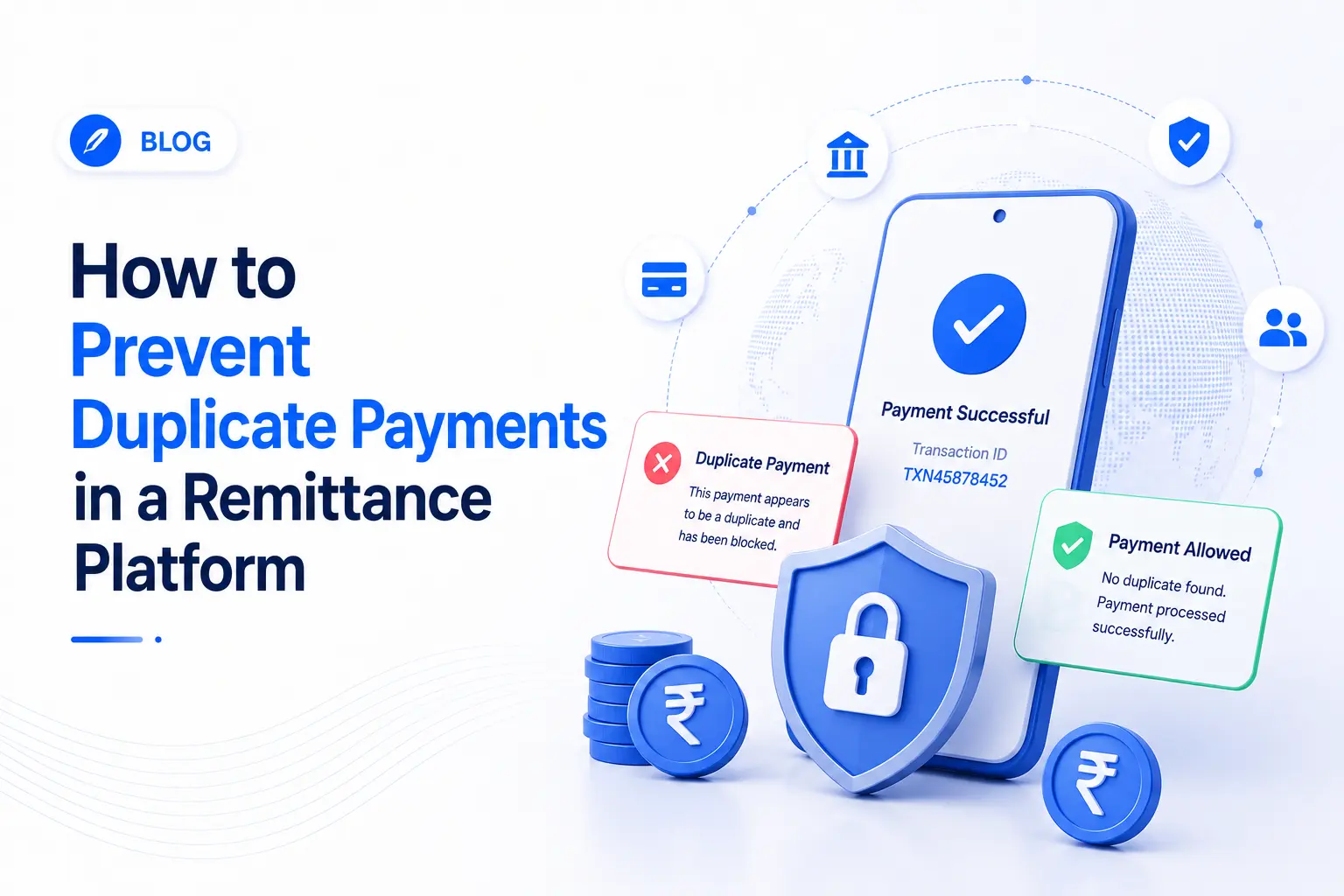
How to Prevent Duplicate Payments Building Attempt-Level Safeguards Into a Remittance Platform